


Overview
The EPEVER UPower-Hi hybrid inverter charger combines MPPT solar charging, AC (utility/generator) charging, and DC-to-AC pure sine wave inversion with energy management. The UPower-Hi hybrid inverter charger supports battery mode and non-battery mode, with multiple charging and AC output priority modes for flexible system operation.
For product selection and system compatibility support, contact https://tsolar.top/ or service@tsolar.top.
Key Features
- Full intelligent digital energy storage equipment
- Supports battery mode or non-battery mode
- Non-battery mode: charging with solar (Main) and utility (Assist) simultaneously
- (Optional) surge and reverse connection protections to support lithium battery systems
- Advanced SPWM technology and pure sine wave output
- PFC technology for AC-to-DC charging (high power factor; reduced grid capacity usage)
- Full digital double closed-loop control
- MPPT tracking efficiency: ≥99.5%
- Three charging modes: Solar only, Solar priority, Utility & Solar
- Two AC output modes: Utility priority, Inverter priority
- Self-learning SOC display function
- Multiple LED indicators for status display
- AC OUT button for direct AC output control
- 4.2-inch LCD to monitor and modify system parameters
- Remote temperature compensation for batteries
- Optional WiFi or GPRS remote control via RS485 isolated communication port
- Optional BMS-Link port (charging/discharging control from BMS)
- Customized charging current and discharging limited current
- Supports cold start and soft start
- Comprehensive electronic protection features
Specifications
System diagram (connection concept)
- Energy sources: Utility input and PV array
- Storage: Battery connection
- Load: AC load output
- Circuit breakers are used on the utility/AC load side and on PV/battery connections
Model group: 110/120VAC output versions
| Item | UP2000-HM6021 | UP3000-HM10021 | UP3000-HM5041 | UP3000-HM8041 |
|---|---|---|---|---|
| Rated battery voltage | 24VDC | 24VDC | 48VDC | 48VDC |
| Battery input voltage | 21.6-32VDC | 21.6-32VDC | 43.2-64VDC | 43.2-64VDC |
| Max. battery charging current | 60A | 100A | 50A | 80A |
| Inverter output | ||||
| Continuous output power | 2000W | 3000W | 3000W | 3000W |
| Max. surge power (3S) | 4000W | 6000W | 6000W | 6000W |
| Output voltage | 110VAC (-3% to +3%), 120VAC (-10% to +3%) | |||
| Output frequency | 50/60 (±0.2%) | |||
| Output wave | Pure Sine Wave | |||
| Load power factor | 0.2-1 (Load power ≤ Continuous output power) | |||
| Distortion THD | THD ≤ 5% (Resistive load) | |||
| 80% rated output efficiency | 89% | 90% | 91% | 91% |
| Max. rated output efficiency | 88% | 88% | 90% | 90% |
| Max. output efficiency | 90% | 92% | 92% | 92% |
| Switch time | 10ms (utility output → inverter output), 15ms (inverter output → utility output) | |||
| Utility charging | ||||
| Utility input voltage | 88VAC-132VAC (Default), 80VAC-140VAC (Programmable) | |||
| Utility input frequency | 40-65Hz | |||
| Max. utility charge current | 60A | 80A | 40A | 40A |
| Solar charging | ||||
| Max. PV open circuit voltage | 250V, 220V | |||
| MPPT voltage range | 60-200V | |||
| Max. PV input power | 2000W | 3000W | 3000W | 4000W |
| Max. PV charging power | 1725W | 2875W | 2875W | 4000W |
| Max. PV charging current | 60A | 100A | 50A | 80A |
| Equalize charging voltage | 29.2V (AGM default) | 29.2V (AGM default) | 58.4V (AGM default) | 58.4V (AGM default) |
| Boost charging voltage | 28.8V (AGM default) | 28.8V (AGM default) | 57.6V (AGM default) | 57.6V (AGM default) |
| Float charging voltage | 27.6V (AGM default) | 27.6V (AGM default) | 55.2V (AGM default) | 55.2V (AGM default) |
| Low voltage disconnect voltage | 21.6V (AGM default) | 21.6V (AGM default) | 43.2V (AGM default) | 43.2V (AGM default) |
| Tracking efficiency | ≥99.5% | |||
| Temp. compensate coefficient | -3mV/°C/2V (Default) | |||
| General | ||||
| Surge current* | 50A | 60A | 56A | 95A |
| Zero load consumption | <1.6A | <1.6A | <1.2A | <0.8A |
| Standby current | <1.2A | <1.0A | <0.7A | <0.6A |
| Zero/standby note | Zero load: without PV and utility connection, turn on the load output. Standby: without PV and utility connection, turn off the load output. | |||
| Mechanical parameters | ||||
| Dimension (H x W x D) | 607.5 x 381.6 x 127mm | 642.5 x 381.6 x 149mm | 642.5 x 381.6 x 149mm | 642.5 x 381.6 x 149mm |
| Mounting size | 585 x 300mm | 620 x 300mm | 620 x 300mm | 620 x 300mm |
| Mounting hole size | Φ10mm | Φ10mm | Φ10mm | Φ10mm |
| Net weight | 15kg | 19kg | 19kg | 19kg |
Model group: 220/230VAC output versions
| Item | UP2000-HM6022 | UP3000-HM10022 | UP3000-HM5042 | UP5000-HM8042 |
|---|---|---|---|---|
| Rated battery voltage | 24VDC | 24VDC | 48VDC | 48VDC |
| Battery input voltage | 21.6-32VDC | 21.6-32VDC | 43.2-64VDC | 43.2-64VDC |
| Max. battery charging current | 60A | 100A | 50A | 80A |
| Inverter output | ||||
| Continuous output power | 2000W | 3000W | 3000W | 5000W |
| Max. surge power (3S) | 4000W | 6000W | 6000W | 8000W |
| Output voltage | 220VAC (-6% to +3%), 230VAC (-10% to +3%) | |||
| Output frequency | 50/60 (±0.2%) | |||
| Output wave | Pure Sine Wave | |||
| Load power factor | 0.2-1 (Load power ≤ Continuous output power) | |||
| Distortion THD | THD ≤ 3% (Resistive load) | |||
| 80% rated output efficiency | 92% | 92% | 92% | 92% |
| Max. rated output efficiency | 91% | 91% | 90% | 91% |
| Max. output efficiency | 93% | 93% | 93% | 93% |
| Switch time | 10ms (utility output → inverter output), 15ms (inverter output → utility output) | |||
| Utility charging | ||||
| Utility input voltage | 176VAC-264VAC (Default), 90VAC-280VAC (Programmable) | |||
| Utility input frequency | 40-65Hz | |||
| Max. utility charge current | 60A (When the utility input voltage is 90VAC-180VAC, max. utility charge current is 30A) | 80A (When the utility input voltage is 90VAC-180VAC, max. utility charge current is 40A) | 40A (When the utility input voltage is 90VAC-180VAC, max. utility charge current is 20A) | 60A (When the utility input voltage is 90VAC-180VAC, max. utility charge current is 30A) |
| Solar charging | ||||
| Max. PV open circuit voltage | 450V, 395V | 500V, 440V | ||
| MPPT voltage range | 80-350V | 120-400V | ||
| Max. PV input power | 2500W | 4000W | 4000W | 4000W |
| Max. PV charging power | 1725W | 2875W | 2875W | 4000W |
| Max. PV charging current | 60A | 100A | 50A | 80A |
| Equalize charging voltage | 29.2V (AGM default) | 29.2V (AGM default) | 58.4V (AGM default) | 58.4V (AGM default) |
| Boost charging voltage | 28.8V (AGM default) | 28.8V (AGM default) | 57.6V (AGM default) | 57.6V (AGM default) |
| Float charging voltage | 27.6V (AGM default) | 27.6V (AGM default) | 55.2V (AGM default) | 55.2V (AGM default) |
| Low voltage disconnect voltage | 21.6V (AGM default) | 21.6V (AGM default) | 43.2V (AGM default) | 43.2V (AGM default) |
| Tracking efficiency | ≥99.5% | |||
| Temp. compensate coefficient | -3mV/°C/2V (Default) | |||
| General | ||||
| Surge current* | 50A | 60A | 56A | 95A |
| Zero load consumption | <1.8A | <1.8A | <1.2A | <0.7A |
| Standby current | <1.2A | <1.2A | <0.7A | <0.7A |
| Zero/standby note | Zero load: without PV and utility connection, turn on the load output. Standby: without PV and utility connection, turn off the load output. | |||
| Mechanical parameters | ||||
| Dimension (H x W x D) | 607.5 x 381.6 x 127mm | 642.5 x 381.6 x 149mm | 607.5 x 381.6 x 149mm | 642.5 x 381.6 x 149mm |
| Mounting size | 585 x 300mm | 620 x 300mm | 620 x 300mm | 620 x 300mm |
| Mounting hole size | Φ10mm | Φ10mm | Φ10mm | Φ10mm |
| Net weight | 15kg | 19kg | 18kg | 19kg |
Note: For the curve of max. PV input power vs. PV open-circuit voltage, see Appendix 1 (as referenced in the specification table).
Applications
- Solar + utility hybrid power systems with battery storage
- Household appliances and general AC loads requiring pure sine wave power
- Power tools, industrial equipment, and audio/electronic devices
Video Demo
Details
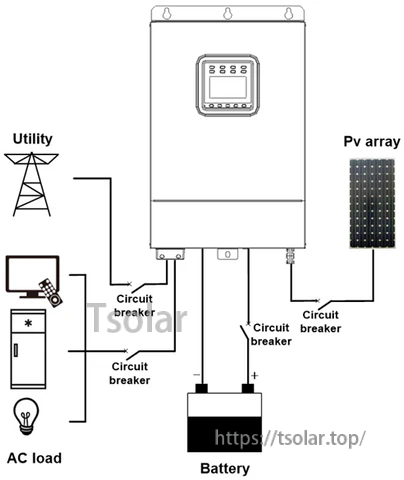
EPEVER UPower-Hi 5000W hybrid inverter wiring uses separate circuit breakers for the PV array, battery, AC load, and utility connections.
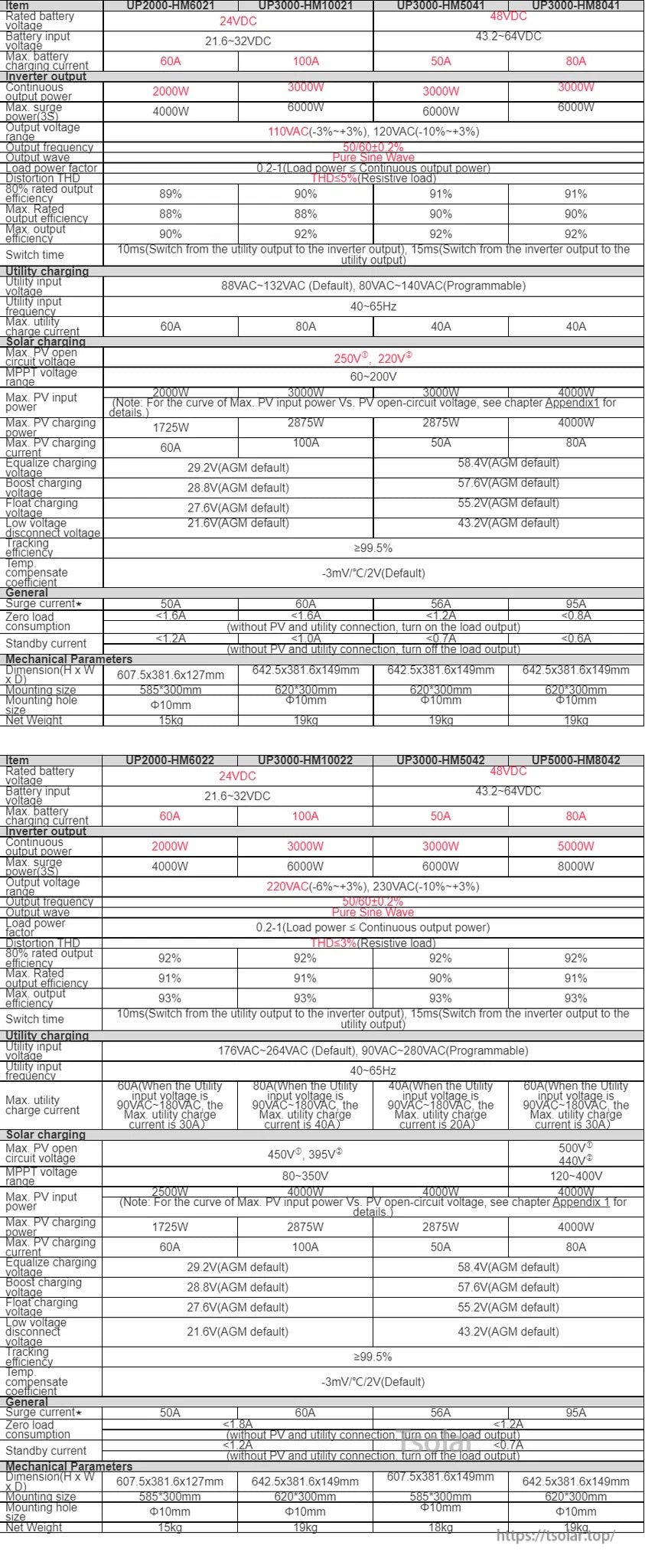
EPEVER UPower-Hi 5000W hybrid inverter specs list key AC input/output, battery, and charging parameters to help with system sizing.


