Overview
The JBD DB24SA03 is a Smart BMS (Battery Management System) designed for lithium battery packs, supporting built-in Bluetooth monitoring and UART communication. It supports 7S–24S LiFePO4 battery packs and 7S–20S Li-ion (ternary/NMC) battery packs, with selectable current options of 40A, 50A, 60A, or 80A for electric products.
Key Features
- Built-in Bluetooth: stable and reliable Bluetooth function for monitoring and parameter setting via mobile app.
- UART communication: supports monitoring/setting through UART (including UART display support).
- Automatic string recognition: can automatically identify 7S–24S lithium battery packs (7S–20S NMC / 7S–24S LFP).
- Multichannel temperature control: three-channel battery temperature sensor (two external channels and one internal channel).
- Snap-on plug design: sampling cables and communication wires use snap-on plugs for a tight connection and stable communication.
- Terminal description: copper tin-plating terminal.
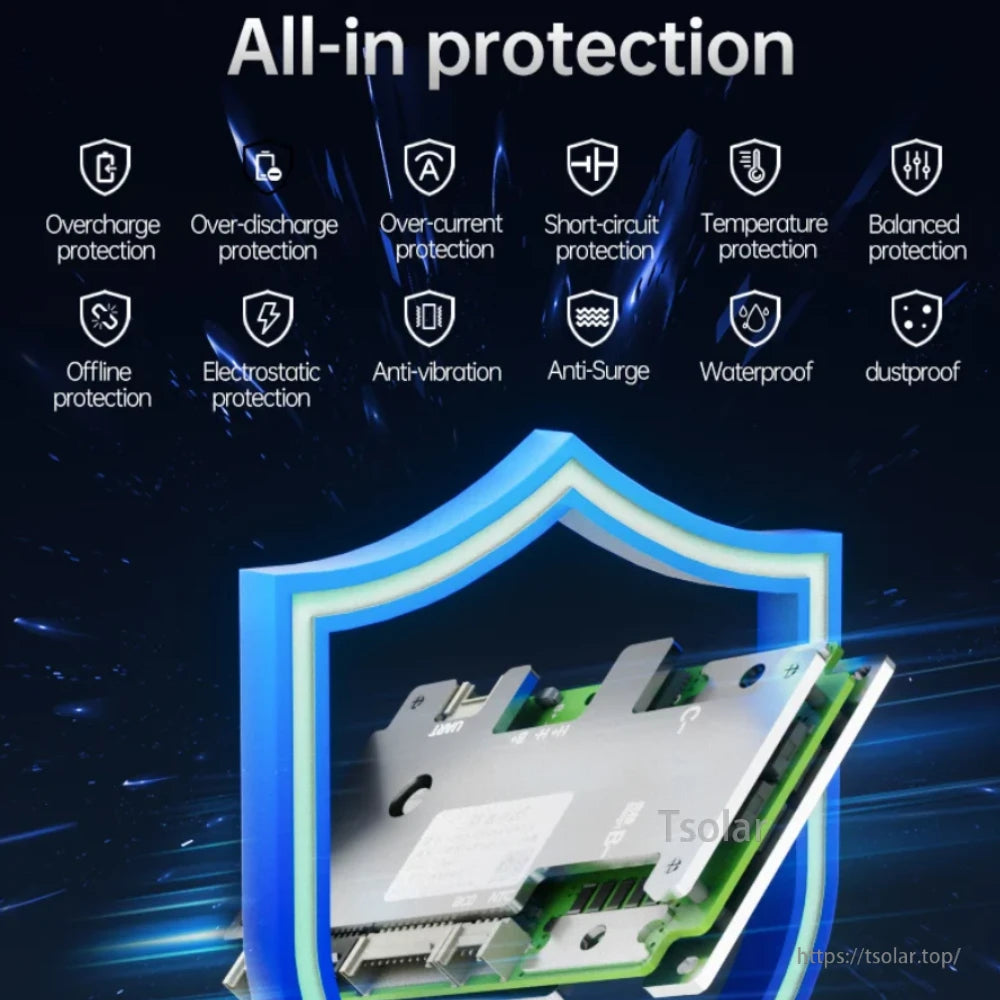
- Protection/feature list (as stated): overcharge protection, over-discharge protection, over-current protection, short-circuit protection, temperature protection, balanced protection, offline protection, electrostatic protection, anti-vibration, anti-surge, waterproof, dustproof.
- Chip/performance statements (as stated): static voltage sampling accuracy up to 10 mV at room temperature; current sampling accuracy up to <= 2%@FS; 5000 W ultra high power TVS; TOLL packaged MOS transistor; “temperature rises less during work”.
- App & platform statements (as stated): Xiaoxiang APP supports checking data and viewing items such as overcharge, overdischarge, overcurrent, temperature, balance, etc; supports Battery Info, Modify data, Remote OTA upgrade, Control charging and discharging, Switch battery type, and Battery protection records. A remote management platform is also described with APP + cloud features including remote operation, batch management, cloud storage, multi-level sub accounts, and remote OTA upgrade/maintenance.
Specifications
| Product name | Battery Management System |
| Type | Smart BMS |
| Model | DB24SA03 |
| Size | 128mm * 70mm * 15mm |
| Voltage | 24V; 36V; 48V; 60V; 72V; 84V |
| Current options | 40A; 50A; 60A; 80A |
| Supported strings | 7s-24s (Lifepo4); 7s-20s (Li-ion) |
| Communication | UART |
| Bluetooth support | Yes (Built-in Bluetooth) |
| Display support | Yes |
| Display type | UART Display |
| Application | Electric Products |
Wiring Notes (Short-Wiring Method)
7S cable short-wiring method: Starting from the first cable on the BCO, the first cable is connected to the first negative pole (the total negative electrode starts as the first string). The 2nd~7th cable are sequentially connected to the positive pole of each string. Then, the 8th and 25th are connected to the positive pole of the 7th (the total positive pole of the battery). The 9th~24th should not be connected. (Counting in order, the 25th cable is the total positive pole, the 7th positive pole of the battery pack.)
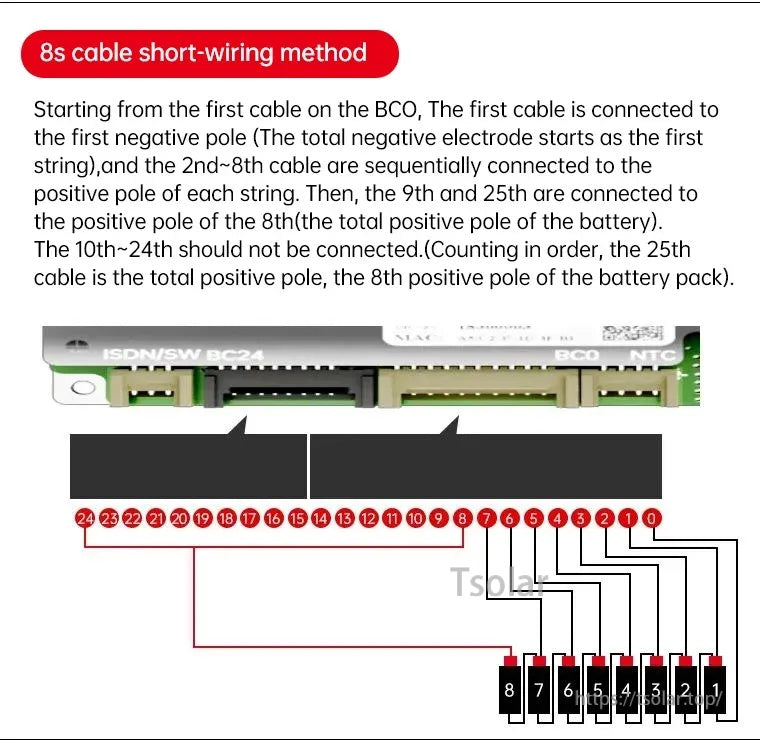
8S cable short-wiring method: Starting from the first cable on the BCO, the first cable is connected to the first negative pole (the total negative electrode starts as the first string). The 2nd~8th cable are sequentially connected to the positive pole of each string. Then, the 9th and 25th are connected to the positive pole of the 8th (the total positive pole of the battery). The 10th~24th should not be connected. (Counting in order, the 25th cable is the total positive pole, the 8th positive pole of the battery pack.)
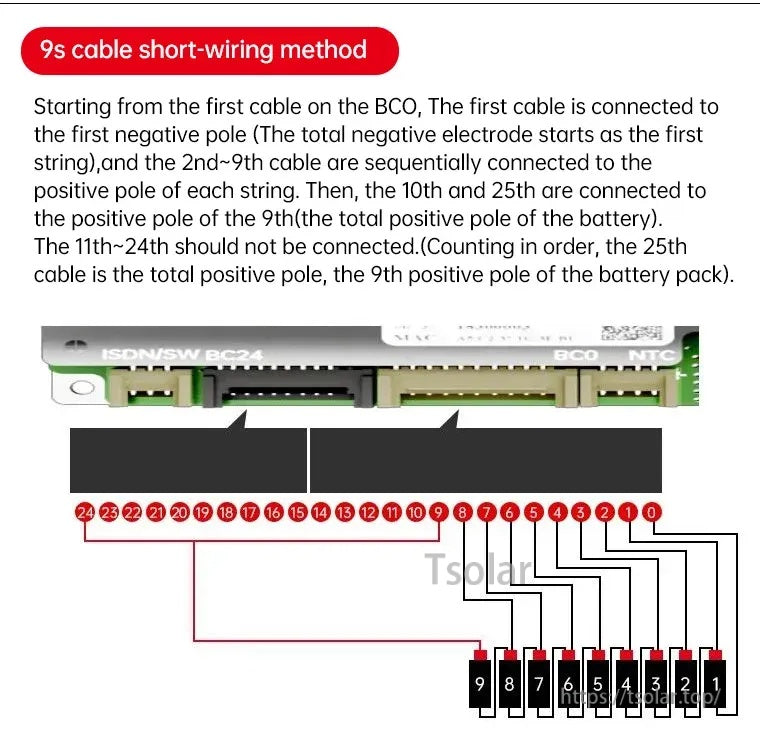
9S cable short-wiring method: Starting from the first cable on the BCO, the first cable is connected to the first negative pole (the total negative electrode starts as the first string). The 2nd~9th cable are sequentially connected to the positive pole of each string. Then, the 10th and 25th are connected to the positive pole of the 9th (the total positive pole of the battery). The 11th~24th should not be connected. (Counting in order, the 25th cable is the total positive pole, the 9th positive pole of the battery pack.)
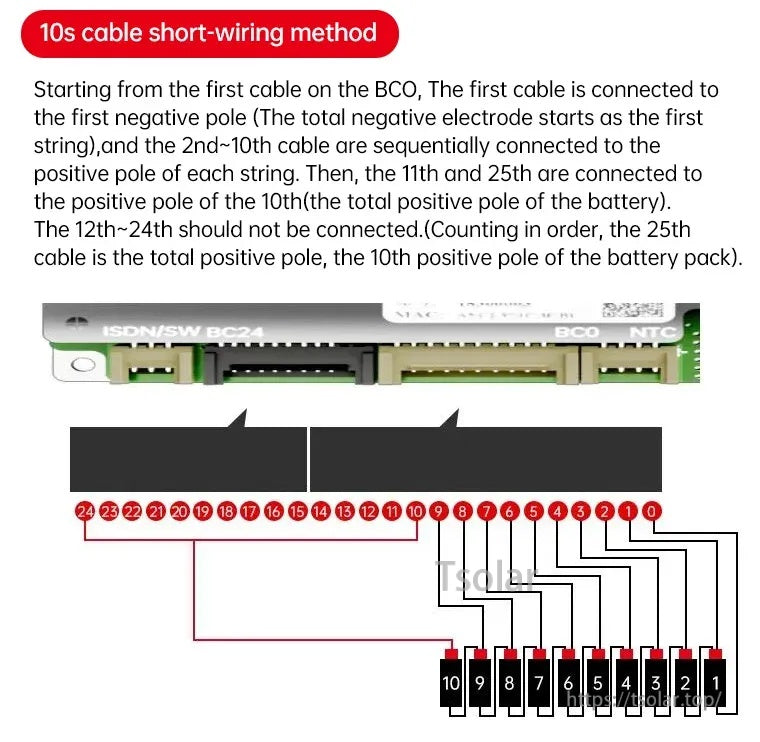
10S cable short-wiring method: Starting from the first cable on the BCO, the first cable is connected to the first negative pole (the total negative electrode starts as the first string). The 2nd~10th cable are sequentially connected to the positive pole of each string. Then, the 11th and 25th are connected to the positive pole of the 10th (the total positive pole of the battery). The 12th~24th should not be connected. (Counting in order, the 25th cable is the total positive pole, the 10th positive pole of the battery pack.)
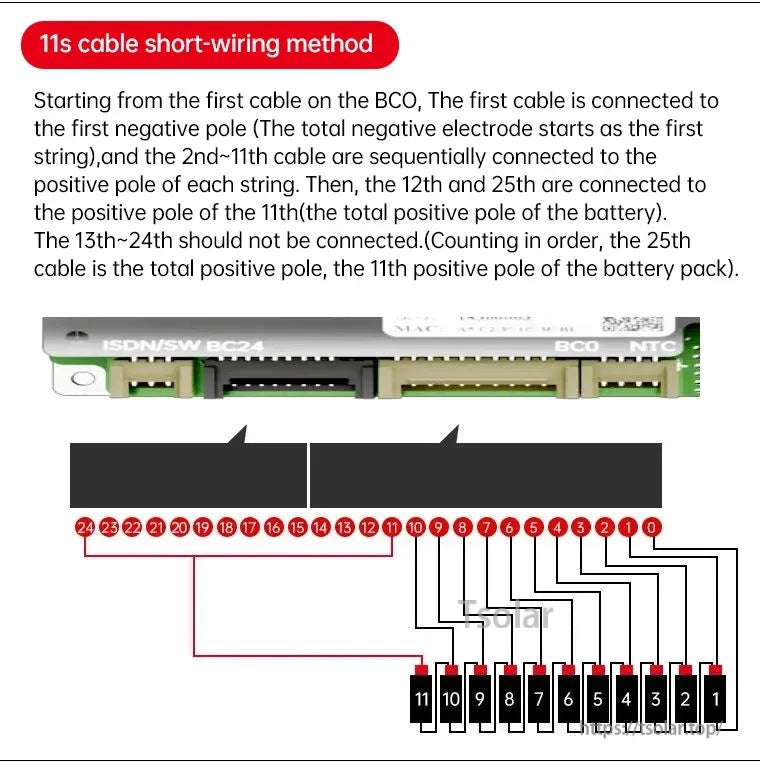
11S cable short-wiring method: Starting from the first cable on the BCO, the first cable is connected to the first negative pole (the total negative electrode starts as the first string). The 2nd~11th cable are sequentially connected to the positive pole of each string. Then, the 12th and 25th are connected to the positive pole of the 11th (the total positive pole of the battery). The 13th~24th should not be connected. (Counting in order, the 25th cable is the total positive pole, the 11th positive pole of the battery pack.)
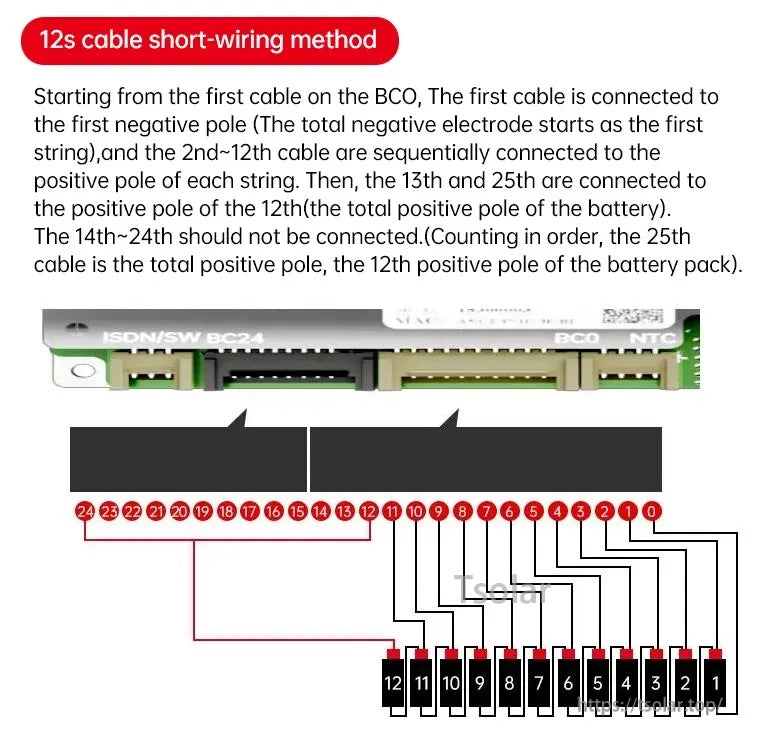
12S cable short-wiring method: Starting from the first cable on the BCO, the first cable is connected to the first negative pole (the total negative electrode starts as the first string). The 2nd~12th cable are sequentially connected to the positive pole of each string. Then, the 13th and 25th are connected to the positive pole of the 12th (the total positive pole of the battery). The 14th~24th should not be connected. (Counting in order, the 25th cable is the total positive pole, the 12th positive pole of the battery pack.)
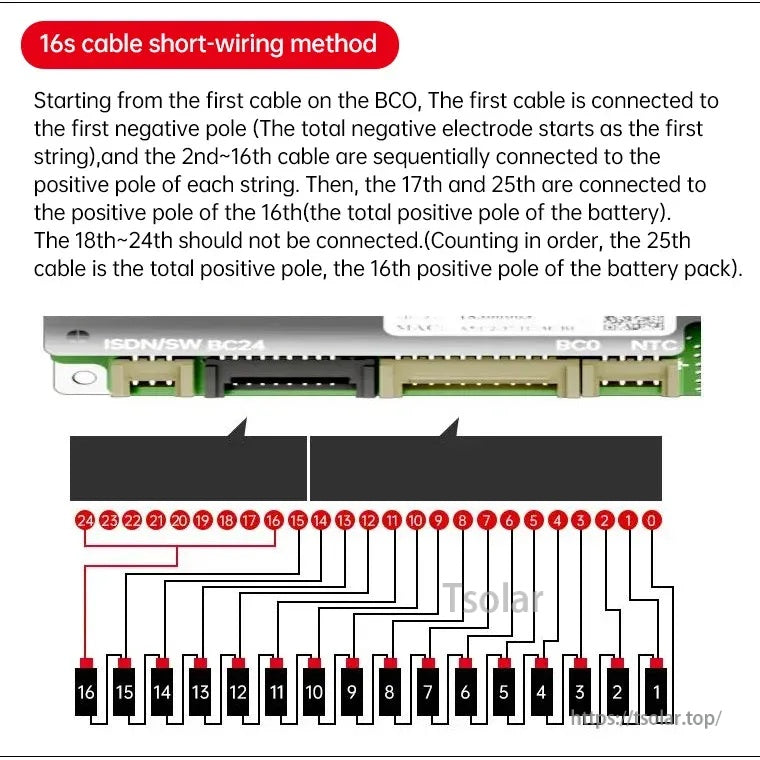
16S cable short-wiring method: Starting from the first cable on the BCO, the first cable is connected to the first negative pole (the total negative electrode starts as the first string). The 2nd~16th cable are sequentially connected to the positive pole of each string. Then, the 17th and 25th are connected to the positive pole of the 16th (the total positive pole of the battery). The 18th~24th should not be connected. (Counting in order, the 25th cable is the total positive pole, the 16th positive pole of the battery pack.)
Applications
- Electric products using lithium battery packs (LiFePO4 7S–24S; Li-ion 7S–20S)
- Battery packs requiring Bluetooth monitoring and UART communication/display
For compatibility questions (cell chemistry, string count, current selection, or wiring), contact customer support at service@tsolar.top or visit https://tsolar.top/.
Software / Tools
- Mobile app: xiaoxiangElectric App (iOS & Android): https://www.jiabaida.com/appdown/index.html
- PC tool: UART – JBD PC Tool Box (software): https://jbdtools.oss-cn-beijing.aliyuncs.com/packfile/JBDTools.zip
- UART LCD displayer: can monitor parameters on an LCD displayer.
Details
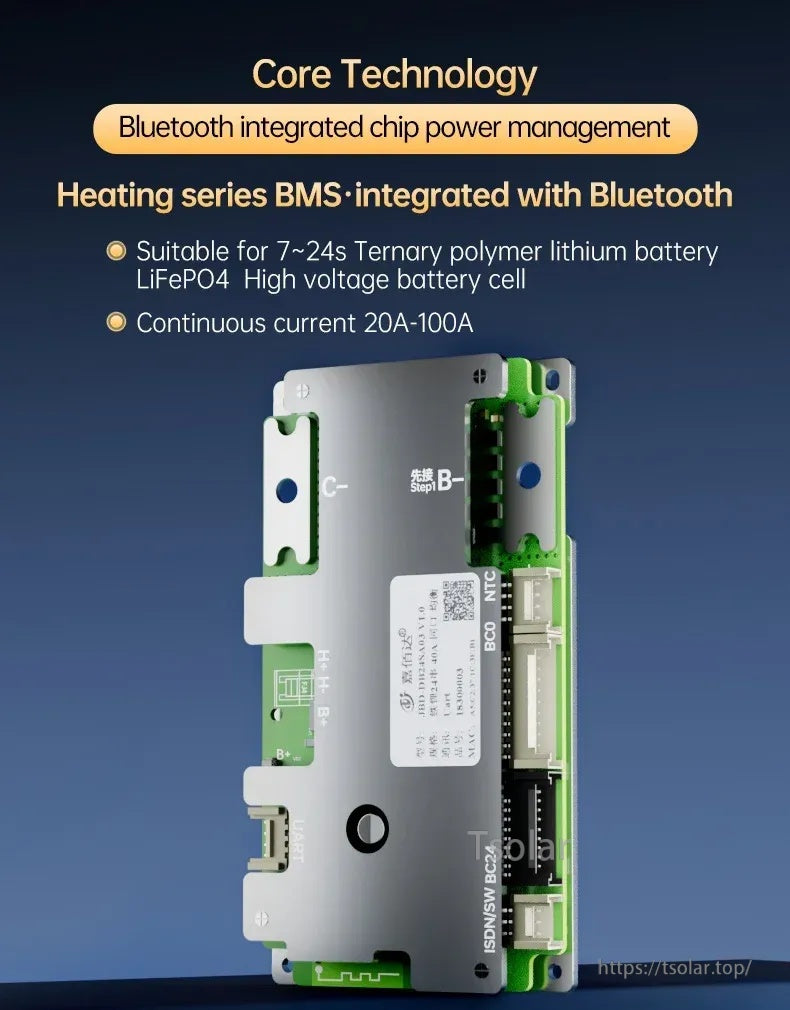
Built-in Bluetooth monitoring and wide series support make the DB24SA03 a flexible choice for lithium battery packs.
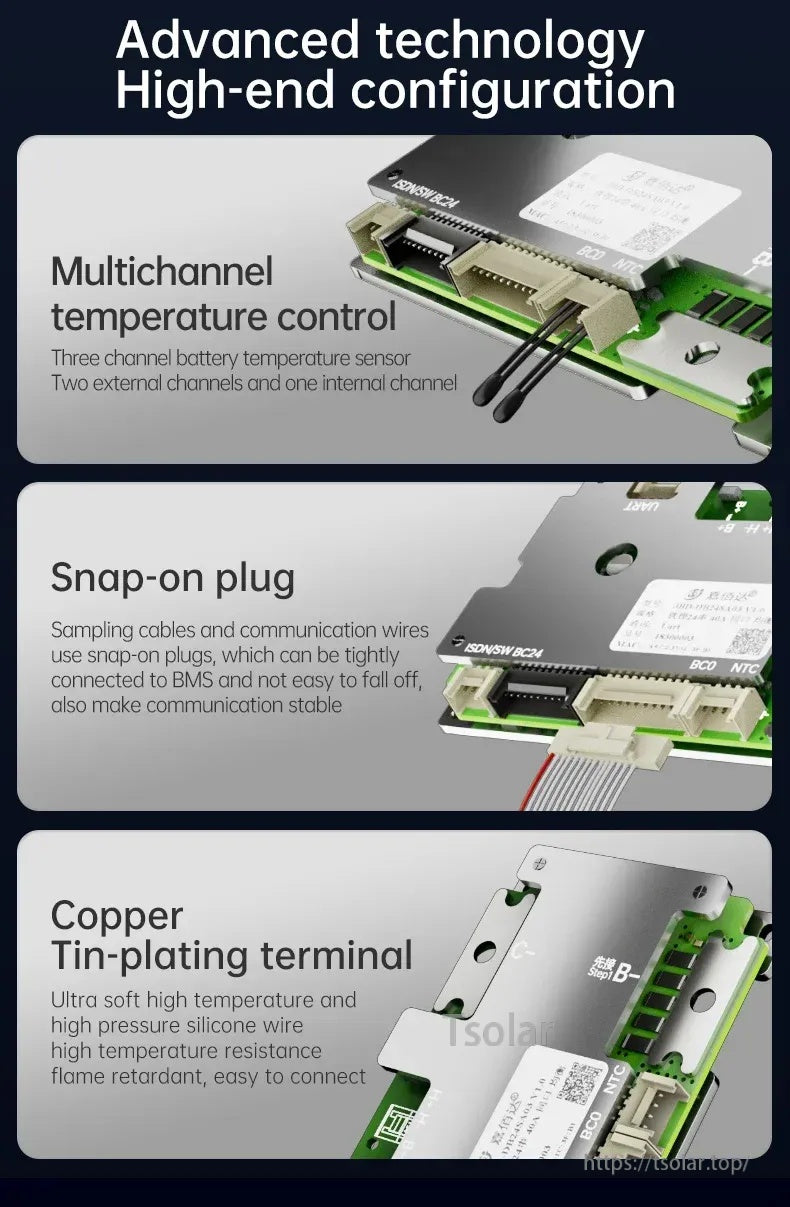
Three temperature-sensor channels and snap-on connectors help keep wiring secure and readings stable in real builds.
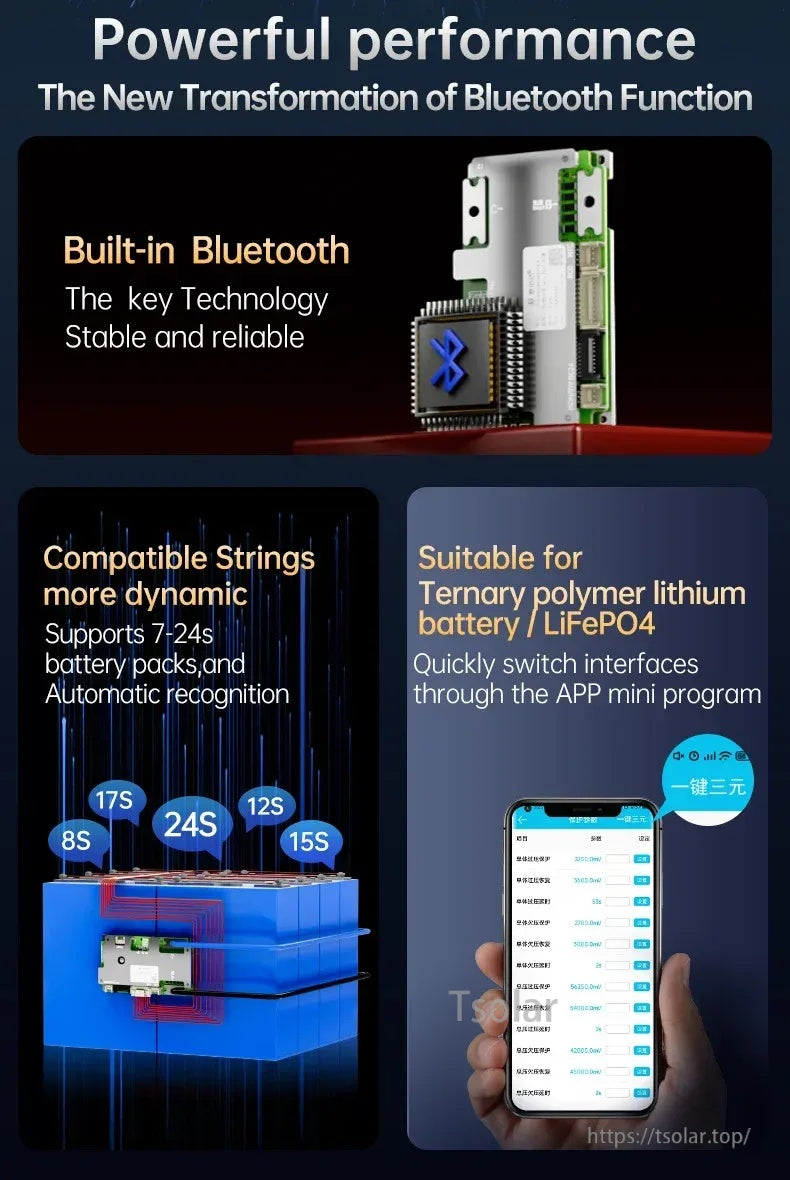
Use the mobile app to view live status, adjust parameters, and manage basic protection and balance functions.
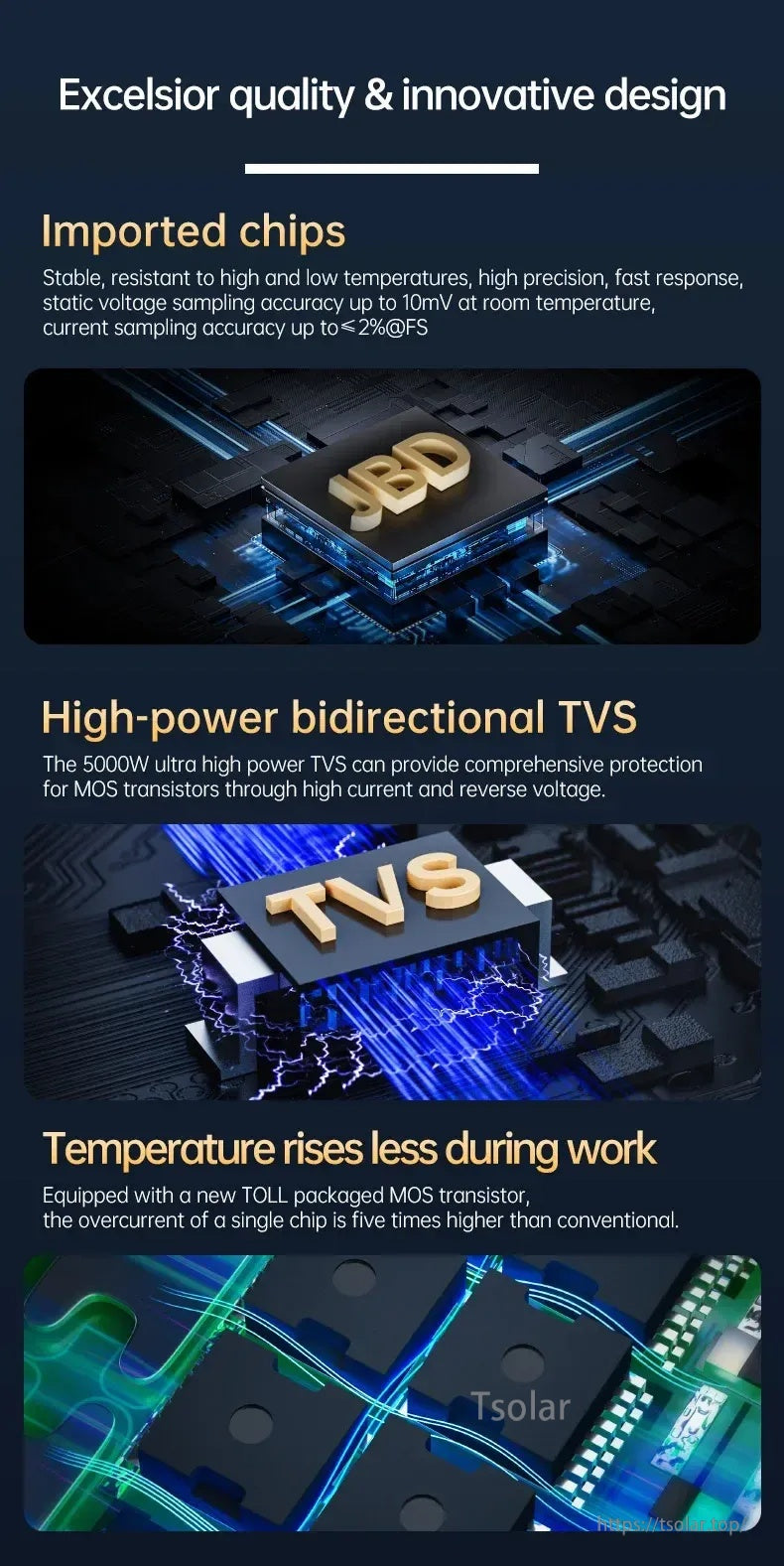
High-power TVS and robust MOS design are emphasized for demanding electric-product applications.
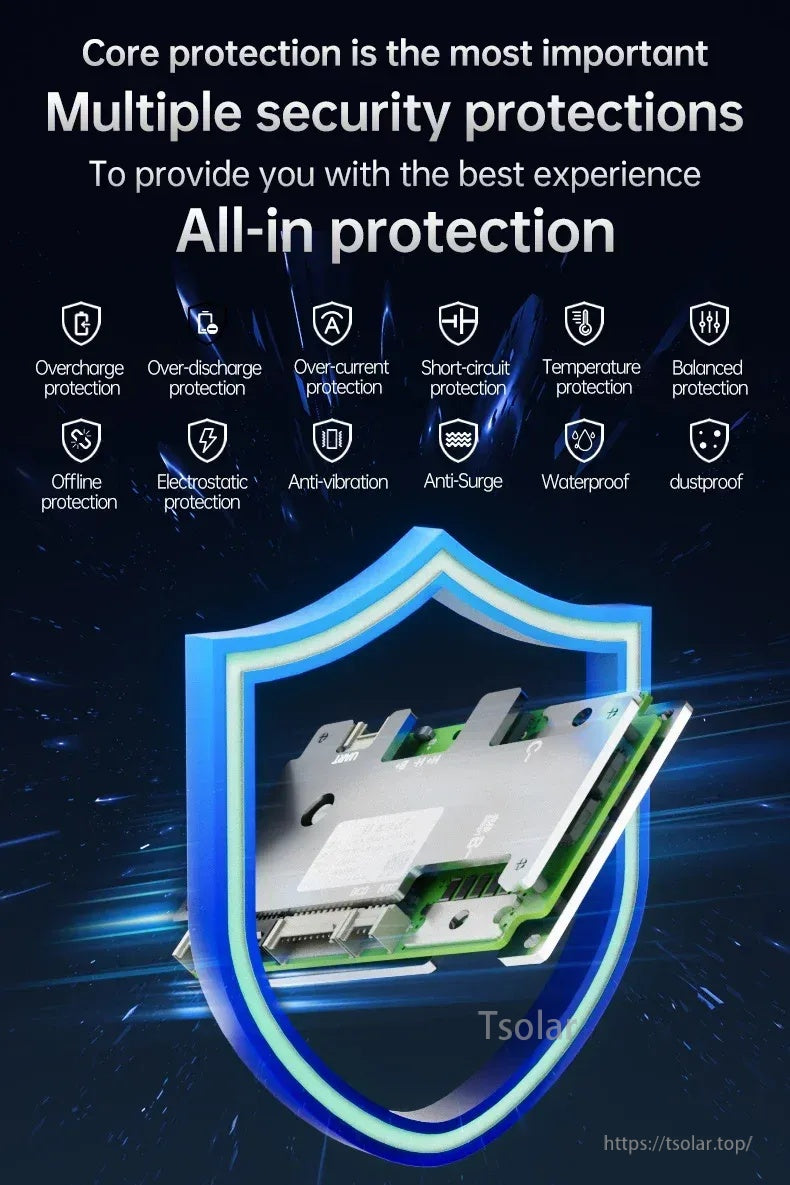
A broad set of protections is listed for everyday pack safety, including voltage, current, temperature, and balance.
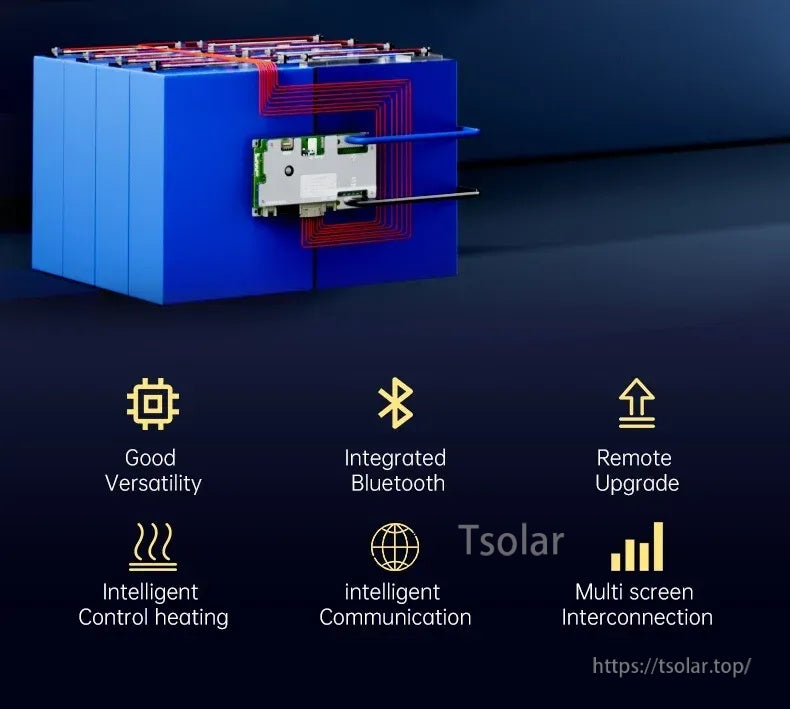
Bluetooth plus remote upgrade support helps simplify setup and ongoing maintenance.
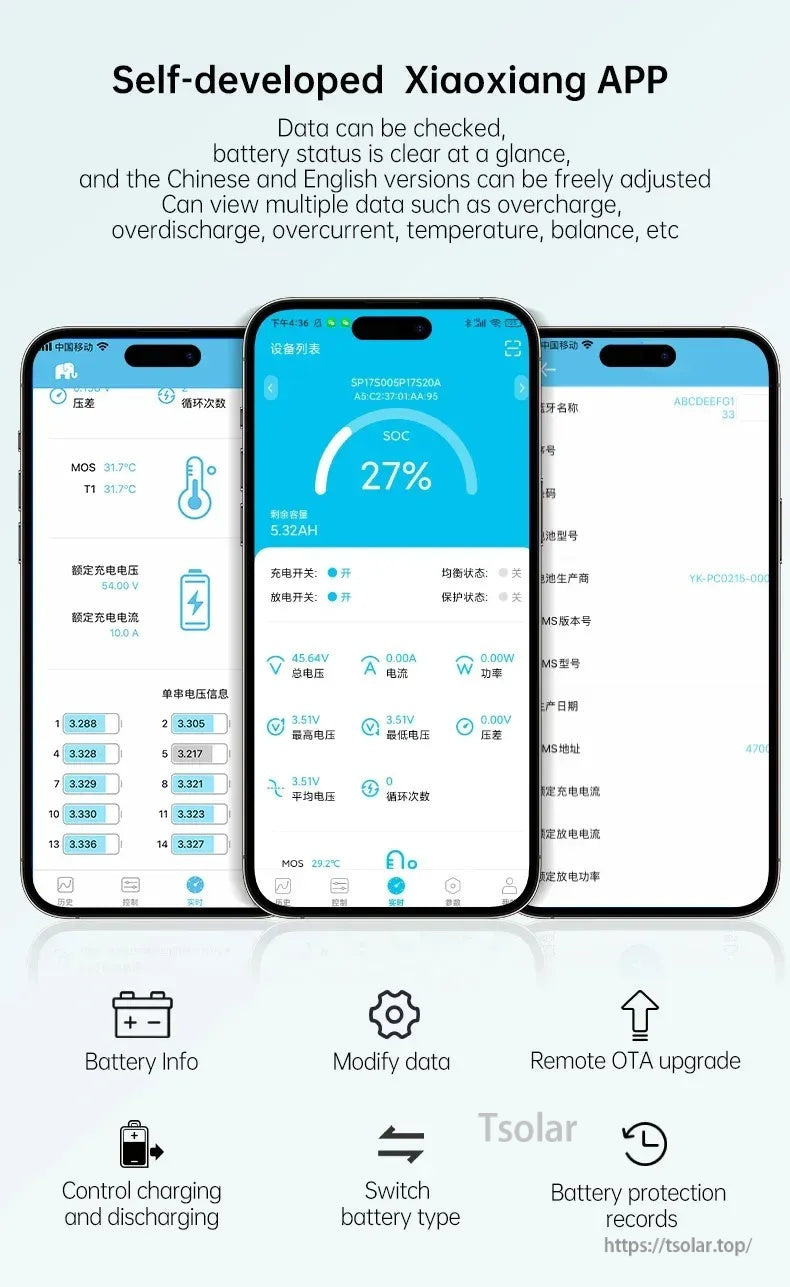
Xiaoxiang APP features include Battery Info, Modify data, OTA upgrade, charge/discharge control, and record viewing.
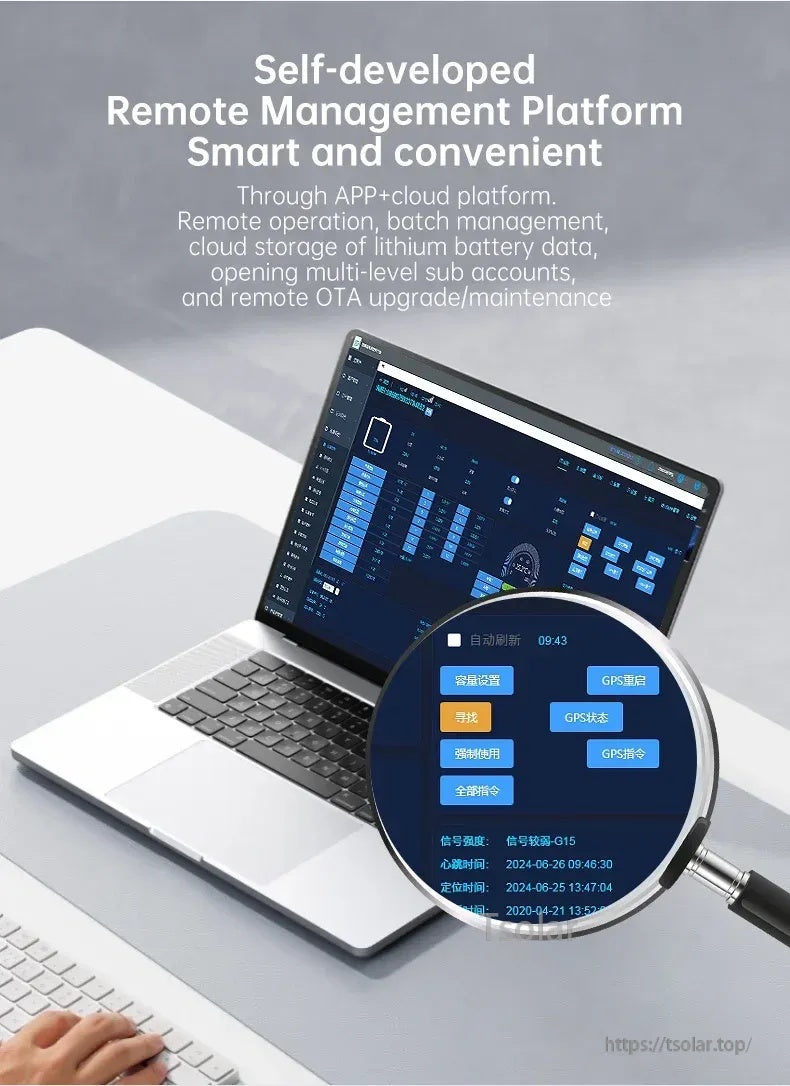
For fleet or batch projects, the remote platform adds cloud storage, multi-level accounts, and remote operations.
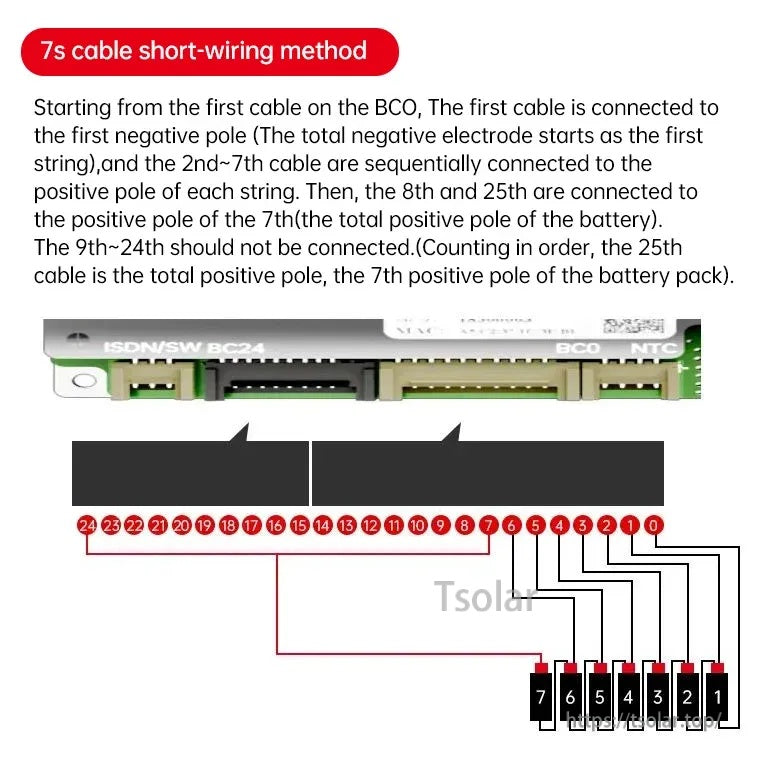
Short-wiring examples help map balance leads to common series counts before final installation.
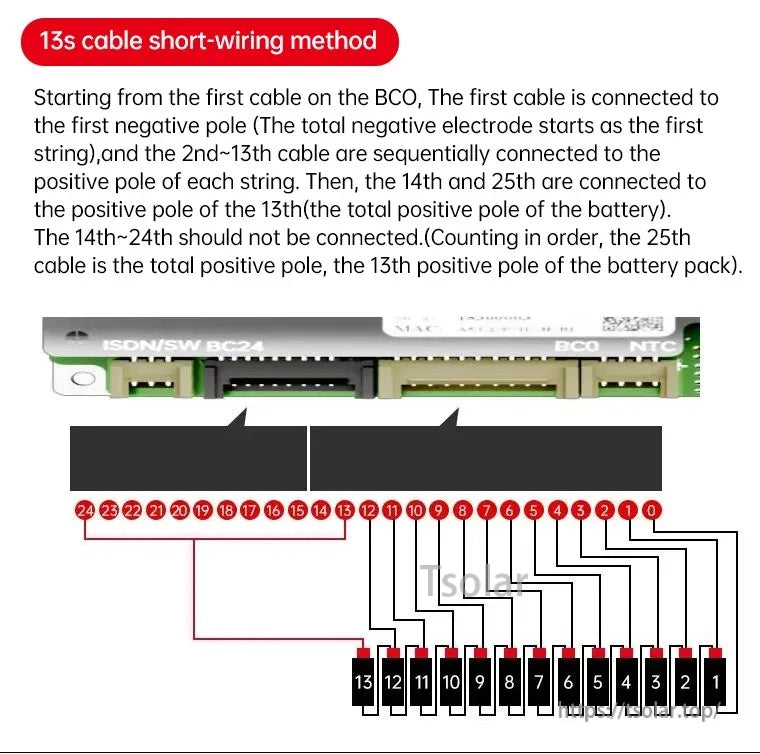
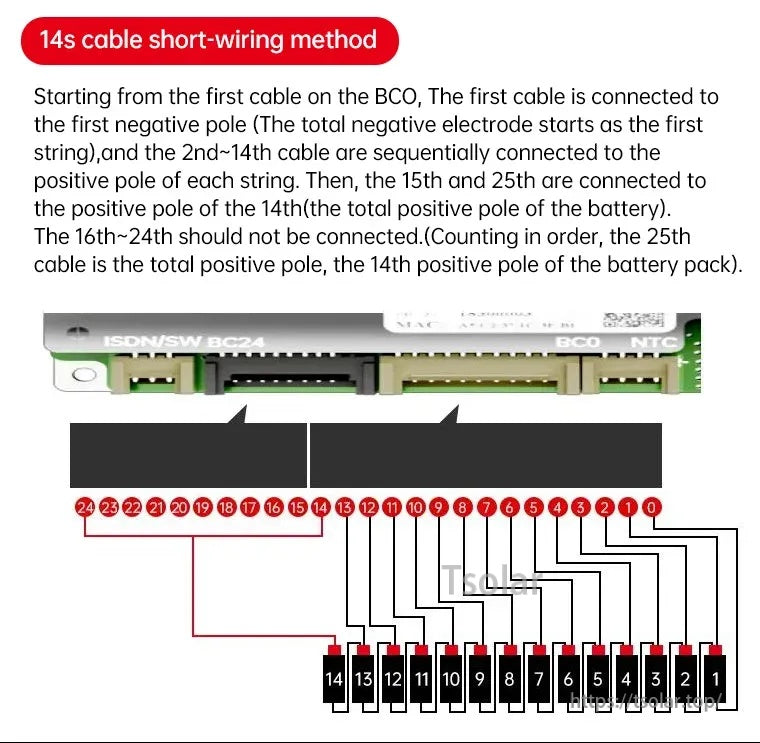
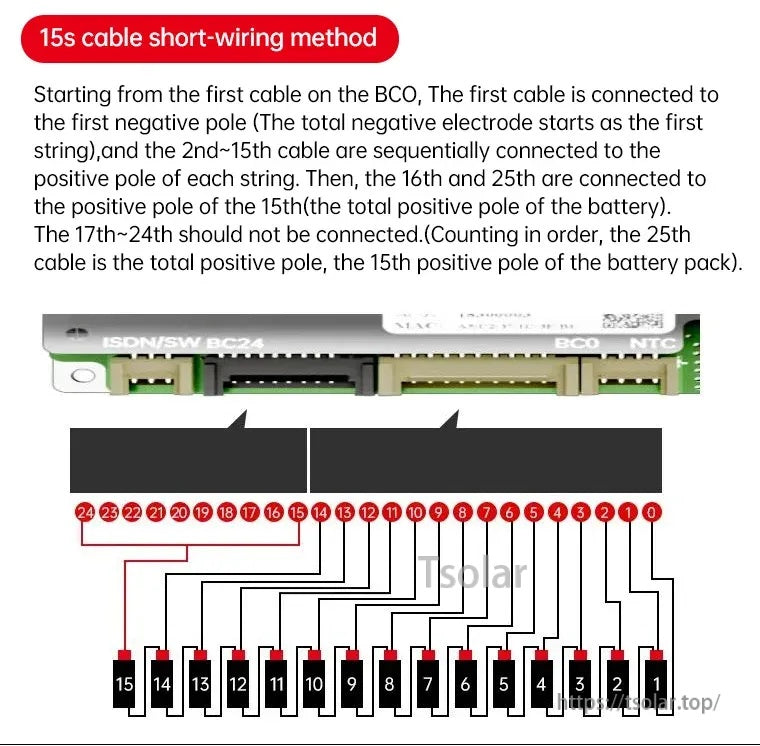
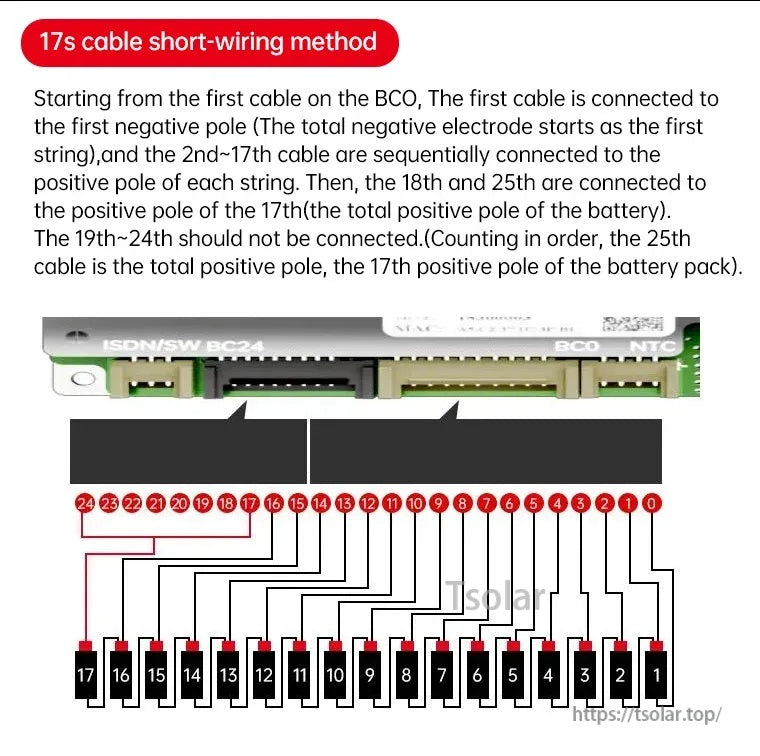
The JBD DB24SA03 smart BMS balance lead guide outlines 17S short-wiring, with taps 1–17 in order and pack positive on leads 18 and 25 while 19–24 remain unused.
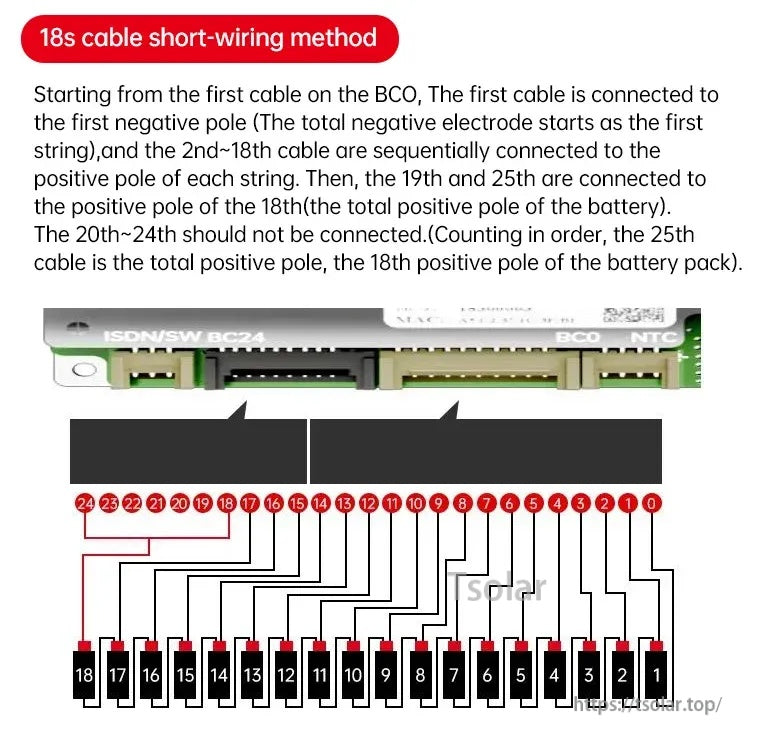
The 18S short-wiring method diagram helps match each balance lead to the correct pin order on the BCO/NTC connector.
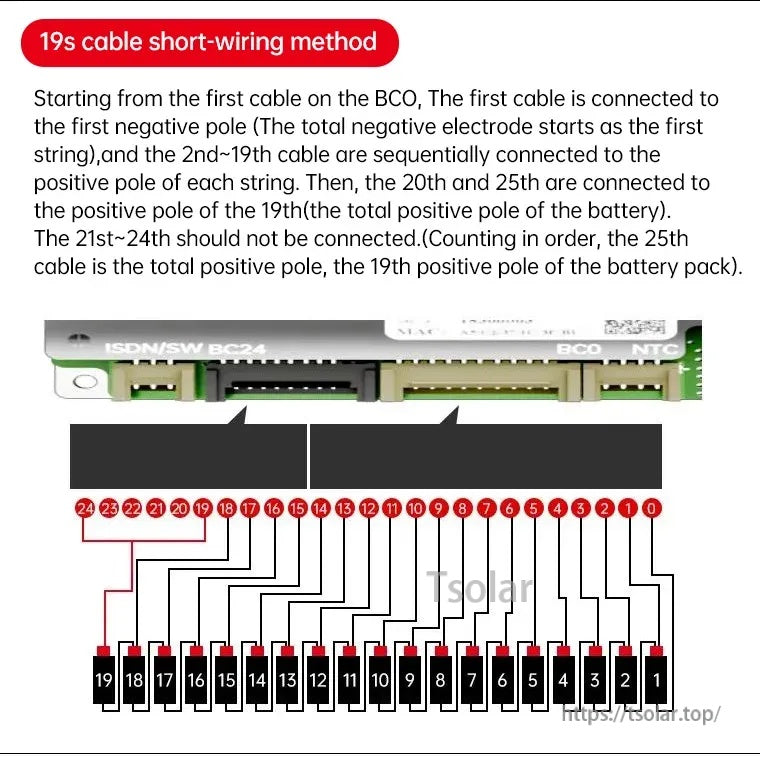
The 19S balance lead diagram maps each cell tap to the BCO connector in order to help prevent wiring mistakes during pack assembly.
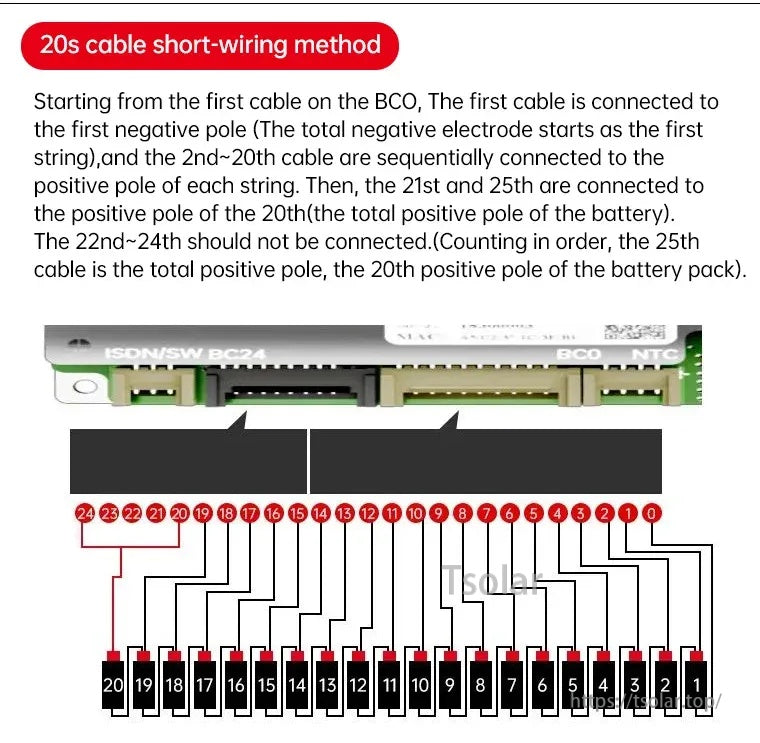
The JBD DB24SA03 Smart BMS uses a 20S balance lead sequence that connects from pack negative through each series cell up to pack positive.
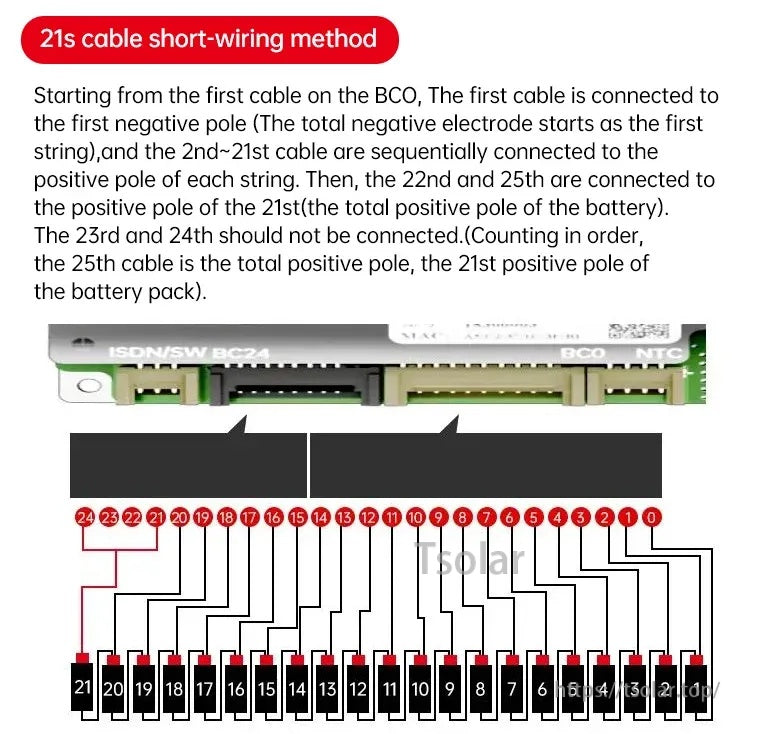
The 21S balance harness connects sequentially from the first negative to each cell positive, with the 23rd and 24th leads left unconnected.
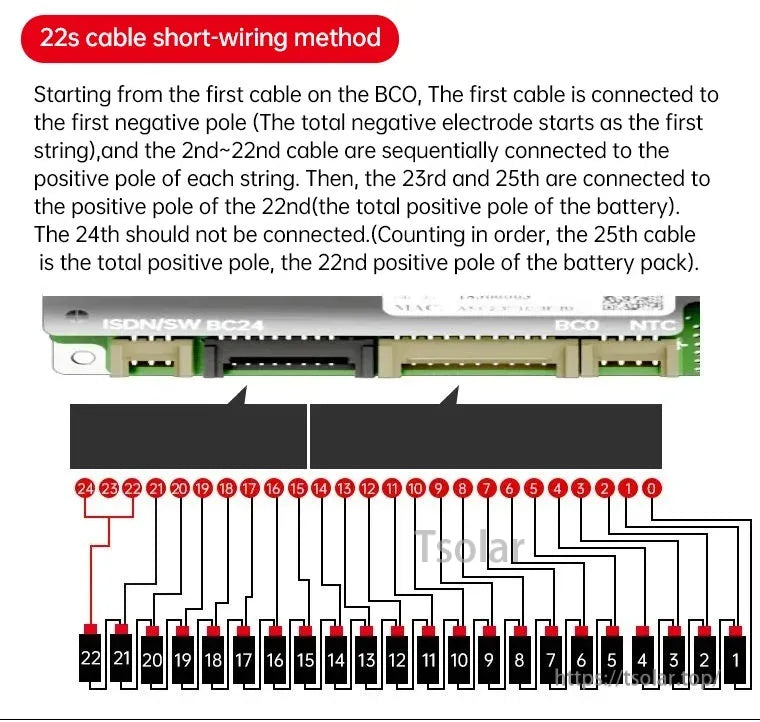
The 22S balance cable connects in order from the first negative lead through the series cell positives, with lead 24 left unconnected per the diagram.
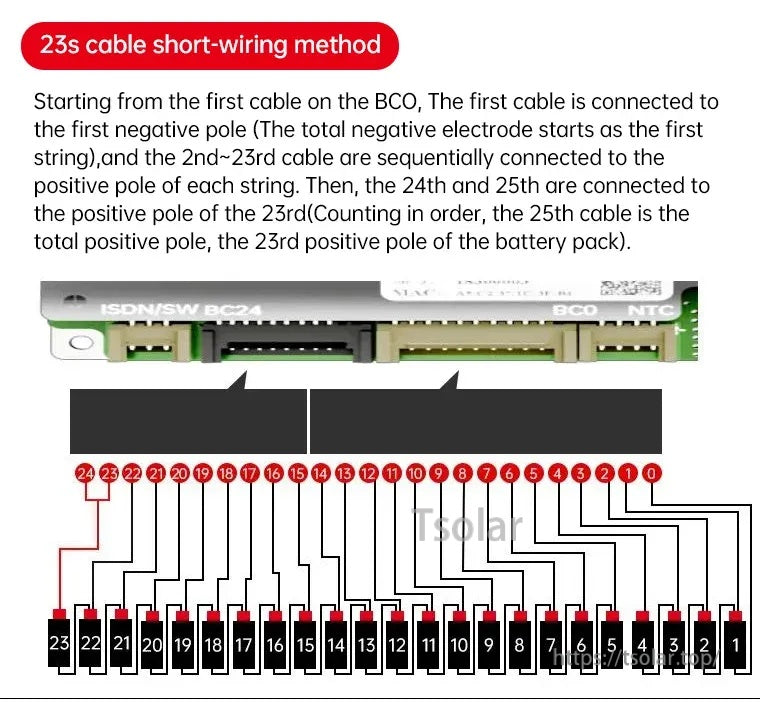
The DB24SA03 BMS uses a 23S balance lead sequence where taps run cell-by-cell and the final leads connect to the pack positive terminal.
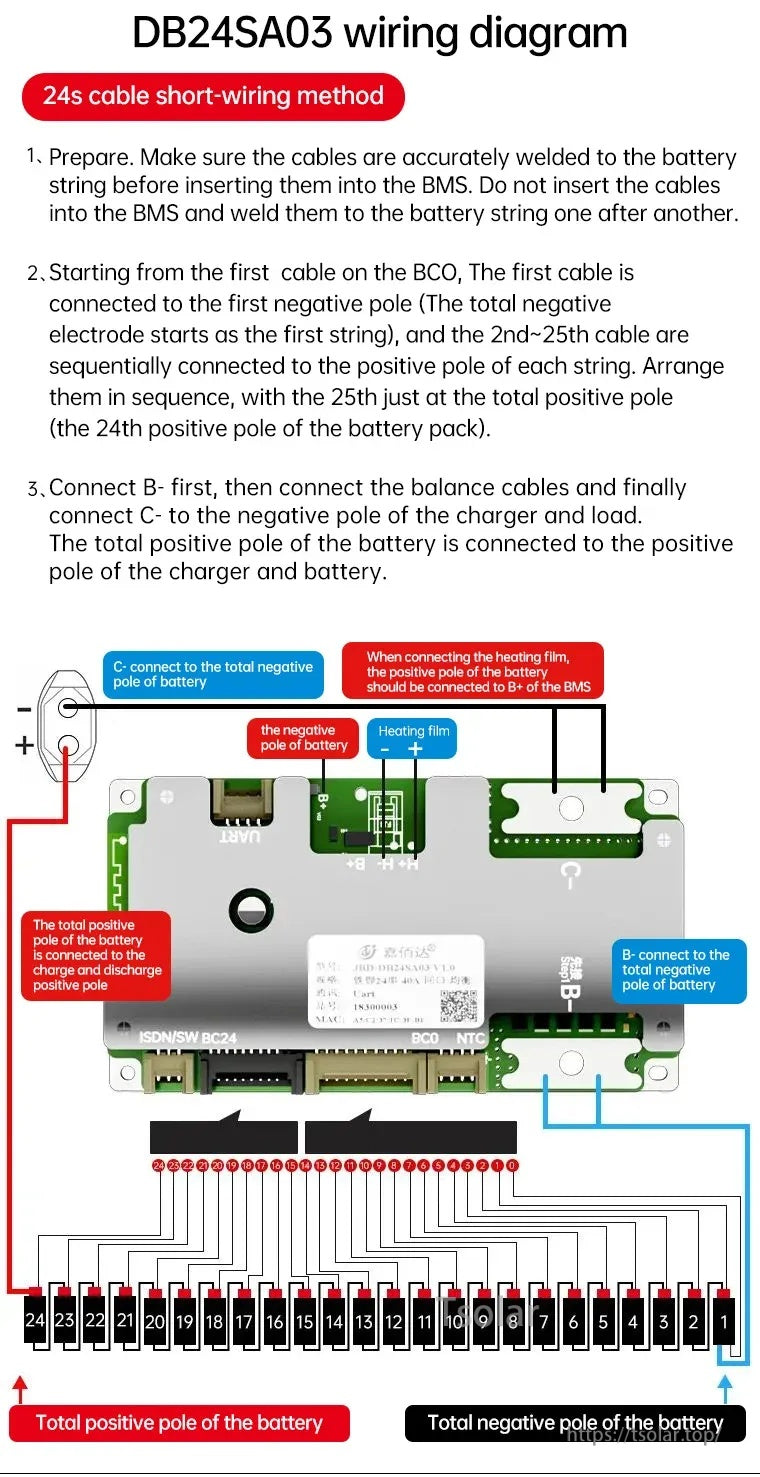
The JBD DB24SA03 smart BMS wiring diagram outlines the 24S balance lead sequence along with B- and P-/C- connections for the battery, load, and charger.